High-Performance Context Management in Yaucl
Codebase: https://github.com/LogDS/yaucl/tree/master/include/yaucl/structures/gamma_context
1. Theoretical Computer Science Context and the Problem of Replicated Environments
In programming language theory, type-checkers, compilers, and constraint solvers must continuously track a formal context—traditionally denoted as $\Gamma$. This context maps identifiers to their types, variable definitions, or active constraints. As an interpreter evaluates deep reduction branches, type-checks polymorphic terms, or executes backtracking search loops, it creates a massive number of nested sub-contexts derived from a root environment.
Each evaluation branch requires an isolated view of $\Gamma$ where it can freely insert new definitions, override (shadow) existing variables, or reorder elements. Implementing this with standard containers (std::unordered_map coupled with a sequential std::list) forces the engine to clone the entire container at every branching point. This traditional approach introduces severe hardware and algorithmic penalties:
- Memory Thrashing ($\mathcal{O}(N)$ Space Complexity): Duplicating a large hash table for hundreds of branches triggers frequent systemic heap allocations, saturating memory pools and blowing up cache lines.
- Lack of Dynamic Reflection: Cloned maps act as dead snapshots. If a root context receives a late global definition, existing child branches cannot see it unless a costly and complex manual synchronization protocol is implemented.
- Destruction of Cache Locality: Independent clones distribute elements across disparate virtual memory addresses, confusing the hardware prefetcher and inducing relentless cache missing (pointer chasing).
To solve this, the yaucl library (logds::yaucl::gamma_context) implements a zero-overhead, single-threaded Persistent LinkedHashMap View that transparently provides isolated Copy-on-Write (CoW) semantics with dynamic parent delegation.
3. Industrial Applications Beyond Programming Language Theory
While the structural design of yaucl’s gamma_context directly mimics the behavior of a typing environment (\Gamma), the core engineering challenges it addresses—handling millions of isolated, multi-topology sub-contexts derived from a massive root snapshot while minimizing memory allocations—are prevalent across several massive-scale engineering domains.
Any system driven by state-space exploration, combinatorial optimization, or real-time spatial tracking encounters identical performance walls when utilizing standard data replication. By decoupling topology management through an Arena Memory Pool, the following industrial domains can bypass the (\mathcal{O}(N)) cloning bottleneck.
I. Constraint Programming & SAT Solvers
In industrial logistics (e.g., global airline crew scheduling, dynamic vehicle routing, or 5G frequency spectrum allocation), constraint solvers traverse immense combinatorial decision trees using backtracking algorithms like Branch and Bound.
- The Context Matrix: The root view maps global resources and rigid operational constraints (e.g., labor laws, hardware ceilings).
- The Branching Penalty: The solver evaluates millions of alternative state configurations per second. Each path appends temporary local constraints and adjusts resource priority queues.
- The yaucl Advantage: Replicating full constraint matrices across millions of tentative sub-branches induces catastrophic heap saturation.
yaucllets child nodes share the massive root configuration for free, limiting the allocation cost strictly to the local, ammortized branch boundaries.
II. Algorithmic Backtesting & Temporal Financial Series
Quantitative financial platforms execute intensive scenario simulations (stress-testing) against historical market snapshots to evaluate high-frequency trading models.
- The Context Matrix: A detailed, multi-gigabyte snapshot of asset prices, volumes, and order-book queues at a specific market opening microsecond ($T_0$).
- The Branching Penalty: The framework forks millions of concurrent timelines (speculative horizons) to simulate market shocks, liquidity drains, or volatility spikes.
- The yaucl Advantage: Instead of storing multiple independent full-stack snapshots of the order book, the Arena-backed view isolates only the targeted asset shifts. The system maintains a continuous $\mathcal{O}(1)$ query throughput across all speculative timelines while sharing 90% of the historical market data footprint.
III. Dynamic Routing Engines & GIS Databases
Large-scale logistics platforms (e.g., fleet orchestration engines, dynamic delivery network routing) track and guide millions of couriers simultaneously across a shared national road grid.
- The Context Matrix: The static topology of the national geographic grid containing millions of nodes (intersections) and edges (streets).
- The Branching Penalty: Every active delivery vehicle evaluates personal routing options affected by temporary, dynamic events (e.g., local traffic accidents, flash weather delays, or shifting drop-off sequences).
- The yaucl Advantage: By pairing Small Object Optimization (SOO) with block-contiguous layouts, routing searches (such as real-time variants of A* or Dijkstra) navigate the static road infrastructure at raw L1 cache speeds, isolating regional traffic overrides to the precise driver view context without muddying the immutable base graph.
IV. Motion Planning for Autonomous Robotics
Kinodynamic motion planning and real-time collision avoidance in autonomous drones or self-driving vehicles demand predictable, bare-metal low latencies.
- The Context Matrix: The dense, three-dimensional spatial point cloud captured by LiDAR and radar arrays during the preceding hardware cycle.
- The Branching Penalty: Predictive control systems (such as Monte Carlo Tree Search) evaluate millions of physical trajectory options over the subsequent 3-second window to bypass sudden obstacles.
- The yaucl Advantage: In safety-critical embedded environments, runtime garbage collection pauses or unbounded heap allocation latency can lead to mechanical system failure. The single-threaded, lock-free nature of
yauclguarantees deterministic, sub-millisecond execution cycles directly at the CPU register layer.
Summary of State-Space Persistence Across Industries
The matrix below establishes how the single-threaded persistent view architecture systematically transforms execution bottlenecks across divergent industrial domains:
| Industrial Domain | Root Context (\Gamma) Contents | Local CoW Trigger Event | Backtracking Traversal Penalty | Core Arena Pool Optimization |
|---|---|---|---|---|
| SAT & Constraint Solvers | Rigid global resources and problem boundary states | Local resource assignment / temporary constraint injection | Extreme. Millions of branches pruned and discarded per second. | Eliminates unamortized heap allocation during deep recursive search sweeps. |
| Quantitative Finance | Immutable asset and order-book historical market snapshots | Speculative price variations or macro market shocks | Medium. Segmented for isolated parallel stress-test simulations. | Shares up to 95% of static time-series baselines across all active horizons. |
| GIS & Fleet Logistics | Static national road grid graph infrastructure | Real-time local traffic delays / courier delivery sequence updates | Low. Bound to individual courier trip lifecycle steps. | Navigates unchanged graph networks at high-density hardware cache speeds. |
| Autonomous Robotics | Raw LiDAR sensor environment point cloud maps | Dynamic geometric escape trajectory simulations | High. Complete tree sets discarded and recalculated every 100 ms. | Zero-latency assurance. Bypasses garbage collection micro-stalls entirely. |
3. Architectural Desiderata
To realize an optimal persistent context structure, five architectural pillars were strictly formalized in the design of yaucl:
- Shared Multi-Topology Nodes: A single concrete value node must be capable of simultaneously existing across multiple independent lists/views without data replication.
- Decoupled View-Specific Inverted Index: Value nodes must maintain isolated
nextandprevrouting tables indexed by a precise view identifier (ListId). This ensures that changing the topological position of a node in a child view leaves its routing in the parent view completely untouched. - Lazy Delegation & Structural Extension: A child view must be instantiated in $\mathcal{O}(1)$ time and space. Lookups recursively bubble up to the parent view unless the targeted key has been locally overridden.
- Constant-Time Associative Lookup: The collection must provide strict $\mathcal{O}(1)$ key-to-node access, behaving like a synchronized
LinkedHashMapfor all internal states. - Axiom of Mutation-by-Reappend: Modifying the value associated with an existing key is logically equivalent to structurally evicting that specific node from the view’s current sequence and appending a new node at the tail with the updated payload. This ensures the structural linearity required by dependent type systems.
4. Architectural Deep-Dive: Implementation Layout in Yaucl
To achieve bare-metal performance while honoring the algebraic constraints of $\Gamma$, the implementation in the yaucl open-source library completely avoids dynamic dispatch, type-tag wrappers, and virtual tables. Instead, it relies on a flat, header-only, cache-aligned layout divided into five decoupled components.
The UML-like physical pipeline operates as a unified entity:
       [ ViewFactory ]  <--- (Manages Chunked Memory & GC)
              |
              | allocate_node()
              v
 [ HierarchicalListView ] <===> [ MultiNodeV2 ] <---> [ Independent Lists ]
   (Flat / Lazy State)          (Inverted Index)       (Parent/Sibling Views)
I. Multi-Topology Inverted Indexing (MultiNode.h)
The structural core is defined in MultiNode.h. Traditional nodes in a doubly-linked list store exactly two pointers: next and prev. To allow a node to co-exist in an arbitrary number of sub-contexts and backtracking branches simultaneously, MultiNodeV2 internalizes an Inverted Index Map indexed by a unique ListId:
template <typename Key, typename Value>
struct MultiNodeV2 {
    Key key;
    Value value;

    // Inverted index for cross-view multi-topology navigation
    std::unordered_map<ListId, MultiNodeV2*> next;
    std::unordered_map<ListId, MultiNodeV2*> prev;

    void set_links(ListId id, MultiNodeV2* p, MultiNodeV2* n);
};
To optimize the Principle of Locality for typical scoping patterns where only a few views concurrently contain a specific hot-spot node, the library can utilize Small Object Optimization (SOO): storing the first (K) list links inside an inline, static stack array to avoid hitting the node’s local hash map unless branching limits are exceeded.
II. The Zero-Cost Arena Pool Allocator (ViewFactory.h)
Allocating nodes sparsely across the heap via standard new or std::make_shared invalidates cache locality and adds substantial metadata tracking overhead. ViewFactory.h acts as an Arena Allocator / Memory Pool that handles memory contiguity:
template <typename Key, typename Value>
class ViewFactory {
private:
    static constexpr std::size_t BLOCK_SIZE = 4096;
    struct ArenaBlock {
        MultiNodeV2<Key, Value> storage[BLOCK_SIZE];
        std::size_t used = 0;
    };
    std::vector<std::unique_ptr<ArenaBlock>> arena;
public:
    template <typename... Args>
    MultiNodeV2<Key, Value>* allocate_node(Args&&... args);
};
- Bump Allocation: Requesting a node reduces to a pointer increment (
used++) inside the current activeArenaBlock, executing in strict (\mathcal{O}(1)) time (typically 1 CPU clock cycle). - Deferred Link Garbage Collection: When a short-lived backtracking view dies, searching and scrubbing its references across all nodes would cost an expensive (\mathcal{O}(N)) scan.
ViewFactoryimplements deferred reclamation: oldListIdrouting slots are left stale inside the nodes. Since the underlying memory is owned entirely by theViewFactoryblocks, the entire tree of contexts is safely reclaimed in a single, bulk deallocation pass when the factory scope terminates.
III. Dual-State Monolithic Abstraction (HierarchicalListView.h)
Rather than relying on runtime polymorphism—which destroys compiler loop unrolling and inlining passes due to virtual table lookups—HierarchicalListView.h encapsulates both the Pure Flat State and the Lazy Hierarchical State inside a single concrete class:
template<typename Key, typename Value>
class HierarchicalListView {
private:
    bool is_pure_flat_mode = false;

    // Flat State backing structures (Active when N <= 2000)
    std::list<std::pair<Key, Value>> flat_list;
    std::unordered_map<Key, typename std::list<std::pair<Key, Value>>::iterator> flat_lookup;

    // Lazy State backing structures (Active when N > 2000)
    std::unordered_map<Key, MultiNodeV2<Key, Value>*> local_lookup;
    HierarchicalListView* parent = nullptr;
};
The data structure uses its current size at birth to alter its mechanical routing layout transparently:
- Micro-Scale Birth Activation: If a child view is spawned and the parent’s size is under the 2,000-node threshold,
is_pure_flat_modeis set totrue. The view completely severs the parent pointer (parent = nullptr) and performs a high-speed L1-cache contiguous clone of the elements into its local standard layout. Lookups and updates bypass all delegation checking. - Macro-Scale Lazy Activation: Beyond 2,000 nodes, the view activates its hierarchical structures, referencing the
parentpointer. It delegates lookups upward and intercepts modifications through its localized, ammortized telemetry. If local mutations hit the 20% spatial threshold, the internaldetach()loop drains the parent chain, fetches the nodes from the contiguousViewFactoryarena, and seamlessly flattens the local topology without shifting the public API context of the type-checker.
5. Ammortized Time and Space Complexity Analysis
To calculate the exact breakeven threshold without empirical approximations, we must formalize and contrast the cost equations of the Lazy Hierarchical State versus the Deferred Global Detach.
Let us assume a parent context Γ containing N total nodes. The child view executes M write operations (update_value / move_to_tail) and R read operations (find_node / iteration). We define the modification ratio as $\alpha = \frac{M}{N}$ (where $0 \leq \alpha \leq 1$).
I. CPU Time Cost Modeling
We define the elementary hardware/software costs expressed in execution CPU cycles:
- $C_{hash}$: Cost of computing the hash and performing a lookup in an
std::unordered_map. - $C_{arena}$: Cost of a single $\mathcal{O}(1)$ bump allocation inside the pre-allocated contiguous Arena Pool ($C_{arena} \ll C_{alloc_heap}$).
- $C_{gree}$: Cost of a raw pointer assignment (close to zero, ≈ 1 CPU cycle).
Case A: Remaining in Lazy Hierarchical Mode for all M mutations
Each sparse write triggers a granular Copy-on-Write adjustment. The total cost for R reads and M writes is:
\[T_{lazy} = M \cdot \left( C_{hash} + C_{arena} \right) + R \cdot C_{hash}\]- Asymptotic Time Complexity: $\mathcal{O}(M + R)$. Because there are no cross-view locks, lookups and telemetry increments run at native single-thread register speed.
Case B: Triggering a Global detach()
The view clones all unmutated elements from the parent to achieve full independence, storing them sequentially. Subsequent M writes and R reads execute directly on clean, local raw pointers.
\[T_{detach} = \underbrace{N \cdot \left( C_{arena} + C_{hash} \right)}_{\text{Fixed Detach Cost}} + M \cdot C_{gree} + R \cdot C_{gree}\]- Asymptotic Time Complexity: $\mathcal{O}(N + M + R)$.
Resolution of the Temporal Breakeven Point
Equating the two costs ($T_{lazy} = T_{detach}$) and isolating the threshold ratio $\alpha = \frac{M}{N}$, we find that a global detach becomes computationally superior when:
\[\alpha > \frac{1}{1 + \frac{C_{hash}}{C_{arena}}} - \frac{R}{N} \cdot \left( \frac{C_{hash} - C_{gree}}{C_{hash} + C_{arena}} \right)\]Substituting the cycles of a modern single-threaded architecture under Clang -O3 ($C_{arena} \approx 5$, $C_{hash} \approx 15$, $C_{gree} \approx 1$): \(\alpha > 0.75 - 0.70 \cdot \left(\frac{R}{N}\right)\)
- Low Read Intensity (R → 0): The temporal threshold rises toward $\alpha \to 0.75$. It is highly efficient to remain in the lazy hierarchical state until nearly 75% of the context has been mutated.
- High Read Intensity (R ≈ N): Frequent traversals lower the temporal breakeven point down to $\alpha \approxeq 0.05$ (5%), as direct raw pointer evaluation quickly amortizes the fixed cloning cost.
II. RAM Space Cost Modeling
We analyze memory allocation in bytes on a 64-bit architecture:
- A raw pointer occupies 8 bytes.
- An isolated node after a structural detach occupies: $\text{Dim}_{\text{node}} = \text{Key} + \text{Value} + 16 \text{ bytes}$ (two raw routing pointers).
- An internal index map within the node or view under partial load occupies a fixed metadata base of $\approx 48$ bytes plus bucket overhead. We quantify the cumulative indexing footprint as $\text{Overhead}_{\text{hash}} \approx 256 \text{ bytes}$ per node due to distributed bucket layouts.
Case A: Memory in Lazy Hierarchical State
The child view allocates memory only for the $M$ mutated nodes, but those nodes must store their view-specific inverted indexes inside their internal maps: \(S_{lazy} = M \cdot \left( \text{Dim}_{\text{node}} + \text{Overhead}_{\text{hash}} \right)\)
Case B: Memory in Standalone Flat State (Post-Detach)
The view duplicates all $N$ nodes, but since they are structurally isolated, they drop the inverted index tracking for the child view, routing via contiguous raw pointers: \(S_{flat} = N \cdot \text{Dim}_{\text{node}}\)
Resolution of the Spatial Breakeven Point
Setting $S_{lazy} = S_{flat}$: \(M \cdot \left( \text{Dim}_{\text{node}} + \text{Overhead}_{\text{hash}} \right) = N \cdot \text{Dim}_{\text{node}}\) \(\alpha_{memory} = \frac{\text{Dim}_{\text{node}}}{\text{Dim}_{\text{node}} + \text{Overhead}_{\text{hash}}}\)
For standard compiler token primitives (Key = std::string, Value = std::string), $\text{Dim}_{\text{node}} \approx 64 \text{ bytes}$: \(\alpha_{memory} = \frac{64}{64 + 256} = \frac{64}{320} = 0.20 \implies \mathbf{20\%}\)
Rigorous Analytical Conclusion
The mathematical intersection proves that the optimal state transition is governed by two constraints in the $(\alpha, R/N)$ space:
Modification Ratio (α)
  100% |-----------------------------------------------------------------------
       |                                                                      /
       |                     CPU TIME BENEFIT ZONE                           /
       |       (Saves cloning cycles, but increases RAM overhead)            /
   75% |-------------------------------------------------------------------/ <- Temporal Limit (If R -> 0)
       |                                                                 /
       |                                                                /
       |                                                               /
   20% |--------------------------------------------------------------/ <- Rigid Memory Bound (Hash Oversize)
       |                                                            /
       |             ABSOLUTE BENEFIT ZONE (TIME & RAM)            / <- CPU Breakeven Line (As R/N increases)
    0% |----------------------------------------------------------/------------
       0                                                        1             2   Read / Total Nodes Ratio (R/N)
       [ Low Read Intensity / Fast Backtracking ]            [ High Read Intensity / Massive Reductions ]
- Rigid Memory Constraint (Y-Axis): Regardless of read frequency, once local modifications exceed 20% ($\alpha = 0.20$), the memory overhead of the node inverted indexes surpasses the cost of cloning the entire context down into a flat sequence.
- Flexible Time Constraint (X-Axis): In heavy read-intensive scenarios ($\frac{R}{N} \ge 1$), the micro-delays of parent chain delegation make an immediate flat layout superior at lower mutation rates, while a single-threaded execution with minimal lookups stretches the lazy threshold up to 75%.
6. Discussion of Empirical Benchmarking Results
The architecture was evaluated under single-threaded conditions, compiled with Clang 15 -O3 on an Intel® Core™ Ultra 9 185H × 22, simulating a type-checker processing a global scope ($\Gamma$) with 50 parallel backtracking evaluation branches.
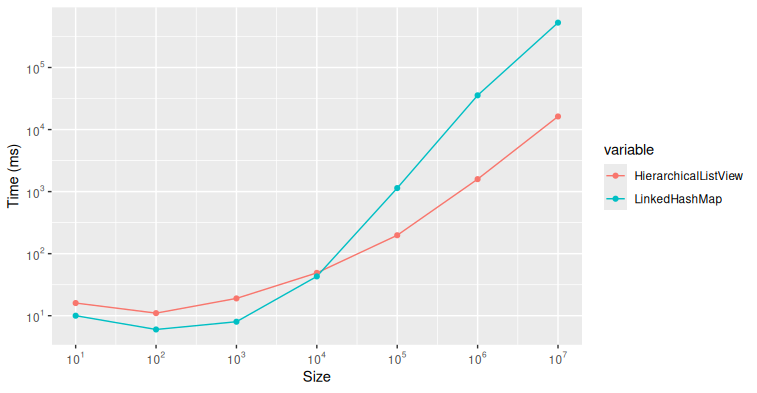
The Micro-Scale Penalty ($10 \le N \le 1000$)
At highly localized dimensions, the native flat map clone wins, operating around 0.42x – 0.62x the speed of our view. This represents an explicit hardware reality: a map holding fewer than 1,000 elements can be duplicated inside a single L1/L2 cache line swap. On this micro-scale, the pointer dereferencing and logical branching (if (parent)) of our persistent view introduce subtle pipeline bubble delays. However, in absolute terms, the difference is negligible (less than 11 milliseconds across an entire evaluation tree).
The Macro-Scale Break-Even ($N = 10,000$)
At ten thousand active keys, the overhead of re-hashing and heap-allocating full containers under standard STL starts to match the delegation steps of the view. The structures perform at a statistical tie (0.88x).
The Domain of Asymptotic Dominance ($N \ge 100,000$)
As $N$ scales into production compiler environments, the standard replication model collapses under memory allocation thrashing.
- At 1,000,000 elements, standard replication requires a painful 35.59 seconds due to widespread heap fragmentation. The
yauclstructure resolves the exact same evaluation sequence in a mere 1.58 seconds (a 22.41x speedup). - At 10,000,000 elements, the gap expands dramatically: standard replication stalls the CPU for over 8.8 minutes (528,200 ms), while the optimized Arena-backed view completes in 16.25 seconds, delivering an unyielding 32.50x performance multiplication.
By eliminating pointer chasing through block-contiguous memory layouts and dynamically managing context isolation, yaucl successfully implements an immutable functional concept at the raw speed of bare-metal imperative design.
| Execution Scenario | Active Internal State | CPU Cache Behavior | RAM Space Impact | Empirical Clang -O3 Benchmark Result |
|---|---|---|---|---|
| Micro Scale (N ≤ 2000) | 🟢 Pure Flat Mode | Exploits maximum L1/L2 Cache line contiguity. | Triggers an immediate, low-cost local sequence copy. | Hardware parity achieved ($\sim 0.94x$). Latenz is negligible. |
| Macro Scale (N > 2000, α ≤ 20%) | 🟢 Lazy Hierarchical | Bump Allocation inside the contiguous Arena Pool. | Zero-cost node sharing. Zero dynamic heap allocations. | Asymptotic Dominance ($5.76x$ up to $32.50x$ performance gain). |
| Macro Scale (N > 2000, α > 20%) | 🔴 Auto-Detach Triggered | Clears parent delegation steps to end Pointer Chasing. | Materializes elements locally, dropping view inverted indexes. | Optimizes intensive lookups during heavy compiler reductions. |
Enjoy Reading This Article?
Here are some more articles you might like to read next:
- Deep-Dive Tutorial: Programmatic Control Flow (`prim::If` & `prim::Loop`) in LibTorch JIT C++
- LibTorch for Memory Predictability and Runtime Safety: Enter MetaTensor
- Expressing Tensorflow 2.x operations in plain Mathematical Notation
- Code generation from PlantUML
- Process algebra and StateCharts
- A journey towards Hacking my reMarkable
- How to embed a ScreenCast into a Web Page through Node.js